
Spring City Directory Collections
No official collection inspected contains a confirmed, continuous Spring-only city-directory run. Spring developed as an unincorporated Harris County community, railroad village, and postal place. The most useful substitutes are Houston-area books, county records, newspapers, and local-history collections. A Houston listing can be a strong lead, but it must not be relabeled as a Spring address without checking the entry, the street guide, and the book's geographic scope.
| Collection | Years | Where Held | Access |
|---|---|---|---|
| HPL digitized Houston directories | 1866-1923 | Houston Public Library digital collection | Free page images |
| HPL and Houston History Research Center shelves | 1866-1986 | Houston local-history collections | Ask staff for the exact volume and scope |
| TSLAC Houston directories | Selected years, 1866-1986 | Texas State Library and Archives Commission | Reference shelf, appointment, or library-loan route |
| Houston reverse and criss-cross titles | 1925-current, title dependent | HPL and Houston History Research Center | Record the exact title, year, and page |
Each row describes a Houston-area resource, not proof of continuous coverage for every Spring postal address. Later shelves may have phone and address details, while the open scans are bounded by copyright and collection access. The library's run is broad, yet a specific edition still needs a scope check before it is used for Spring research.
See the Houston Public Library digital collection before planning a visit. Its collection page is the source for the digitized run shown here.
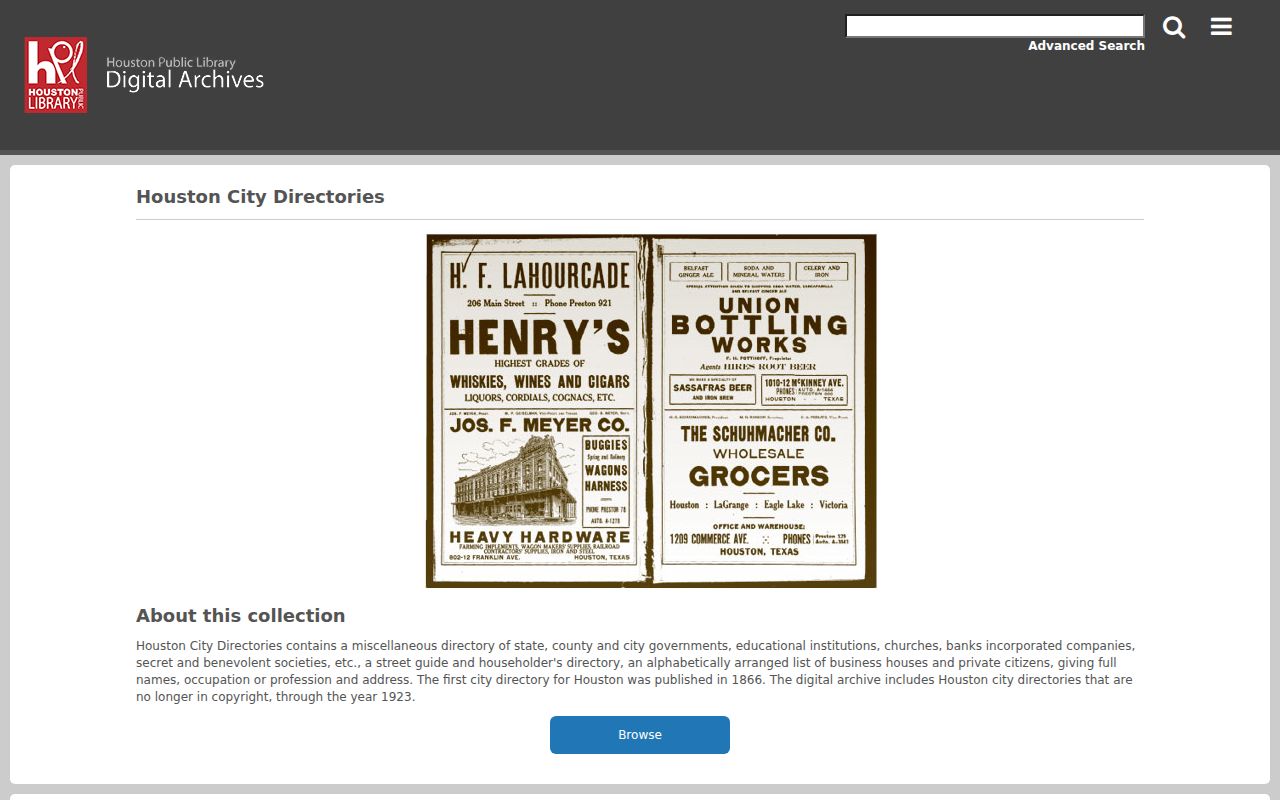
The open collection is useful for checking a printed page directly. It does not establish that a Spring name appears in each Houston volume.
Spring Directory Scope
The local boundary matters before any name search. Some addresses marketed as Spring fall in Houston, Shenandoah, Conroe, or Montgomery County. A Spring postal label is not the same as a city limit, and the Harris County side is not the entire regional footprint. For a nineteenth-century search, the record trail is even less like a modern suburb because Spring was a railroad and post-office community rather than an incorporated city that published its own recurring civic directory.
Label a negative result with care. “No entry found in the examined Houston volume” is useful and honest. “No Spring resident existed” is not. Search the street, surname variants, nearby Houston and Old Town labels, Harris County, and the book's alphabetical and street sections before deciding that the directory did not supply a lead.
Scope check. Keep the city printed in the volume separate from the delivery city on a later address, especially near the Harris and Montgomery county line.
Spring City Directory Entries
A city directory entry is a dated printed observation, not a complete biography. The HPL item for the 1920-21 Houston volume identifies the collection, title, date text, Houston and Harris County subjects, and a PDF object. Within a usable entry, capture the name exactly as printed, street or address, occupation or profession, any household or rooming wording, the page number, the directory year, and whether it came from the alphabetical or street portion. Adjacent entries can help identify a block or a business cluster.
| Name as printed | Preserves the source spelling, initials, suffixes, and possible variants. |
|---|---|
| Street or address | Places the entry in the alphabetical or street portion of that edition. |
| Occupation or profession | May distinguish people with similar names, but does not prove a household relationship. |
| Year and page | Lets another reader return to the same scanned or shelf volume. |
| Entry section | Shows whether the information came from a name list or address-oriented guide. |
- Criss-cross directory
- An address-first directory that can lead from a street to a listed household or phone entry.
- Householder directory
- A portion of a volume organized to identify households or addresses rather than a simple surname list.
- Abbreviation key
- The printed key that explains the volume's shortened terms; photograph or note it before interpreting a line.
The 1920-21 directory item is a good model for recording the source metadata before transcribing a name.
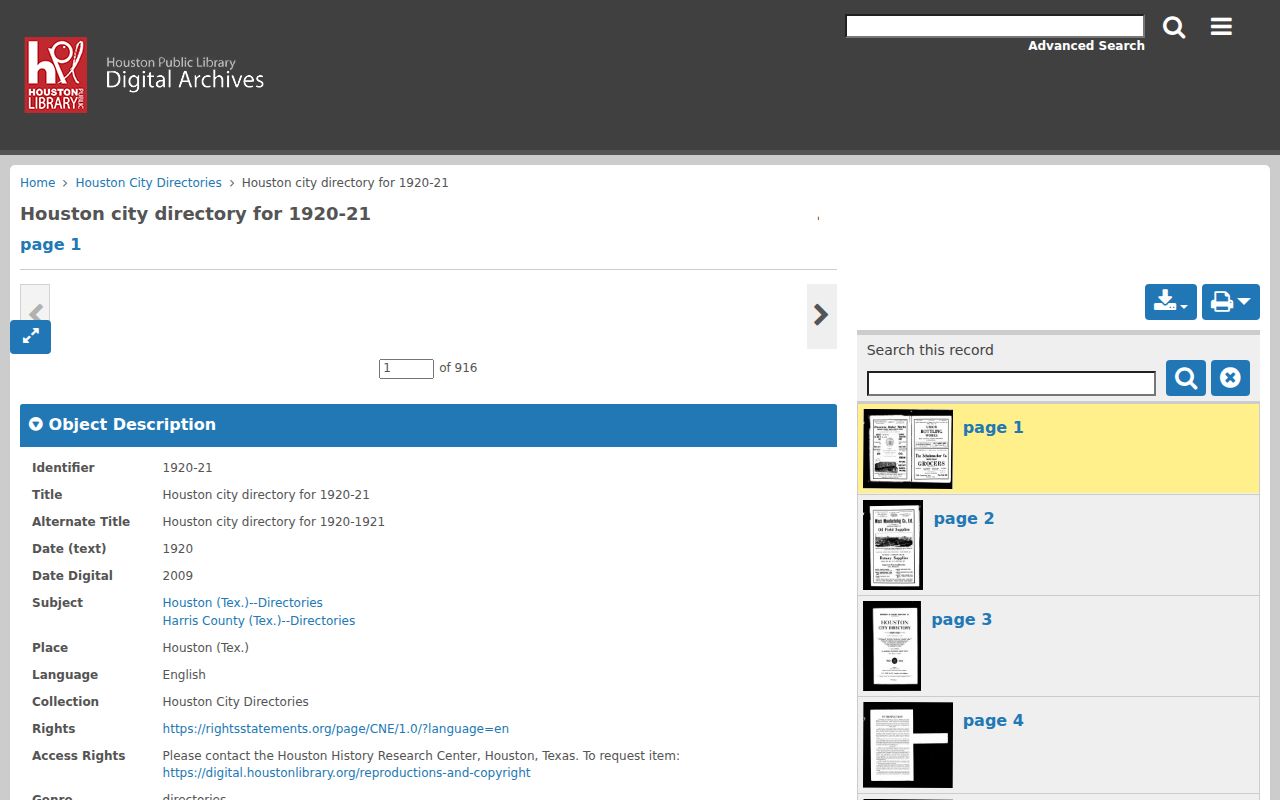
OCR on a scanned page can be imperfect. The page image and the printed abbreviation key control when an automated reading disagrees with the text.
Spring Directory by Address
When the name is unknown, start in the street-and-avenue guide or a reverse title. Houston-area criss-cross directories are described as various titles and publishers from 1925 forward. Find the address in the address order, then turn to the alphabetical section for the corresponding name. Record the publisher, title, year, page, and abbreviations because different titles can format an address in different ways.
This is an occupant clue, not an ownership finding. A directory can suggest who received mail, headed a household, ran a business, or used a listed phone. It does not decide title, and it does not prove that every person at an address lived there. Use the county deed and appraisal records to keep a recorded grantee, an appraisal owner or taxpayer, and a historical occupant in separate columns of your notes.
Spring coverage in a Houston or Greater Houston criss-cross title is not confirmed as continuous. Check the edition's geographic scope before reading an address as Spring.
Spring Historical Shelves
The Texas State Library and Archives Commission city-directory holdings list Houston years from 1866 through selected editions in 1986. The list includes early separate editions, many 1920s through 1940s books, 1951, 1955-59, 1960-67, 1969-78, 1980-82, 1984, and 1986. These volumes are physical state-library reference material, so verify the publisher and edition at the shelf or through a research appointment or library-loan request.
HPL and the Houston History Research Center are the better next stop for a later printed volume or a title not visible in the open scans. Ask whether the shelf volume includes the Spring postal area and whether staff can point to an address guide. There is no official source in the research that identifies a last Spring-specific publisher or a complete Spring-only printed run.
The Harris County Historical Commission directory of societies can also help locate a local-history contact when a family, church, or community name needs context.
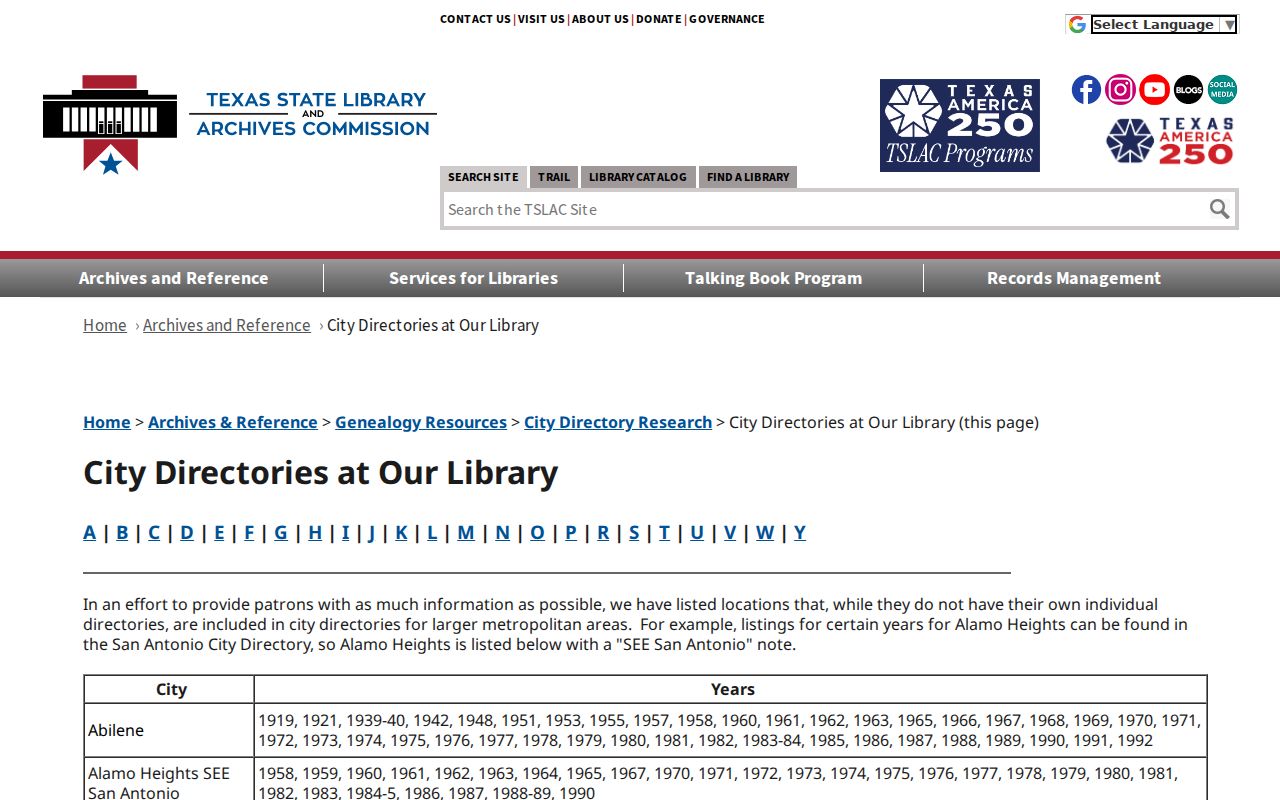
A shelf callout is a route to a source, not a promise that a particular street or surname will appear in the volume.
Spring Address Search Limits
Houston History Research Center staff offer a narrow address-search assist. Their published guidance says staff can check about one address in five years of choice, or two addresses in two or three years per email. The limit is five requests per month, and the service does not perform telephone searches. That makes it well suited to testing an old house address or resolving one hard-to-read line, not compiling a list of households.
Send a precise request: the address as known, spelling variants, the target years, and the result you need confirmed. If the staff response gives a directory lead, preserve the volume year and page. A returned result should still be paired with a census, deed, or obituary before it is treated as a family-history conclusion.
Note: A staff lookup can locate a printed lead, but it cannot replace reading the volume's scope, page image, and abbreviation key.
Spring Directory Family Trail
For a target period that fits the open scans, begin with the 1920-23 material. Search the surname in the alphabetical citizen section, then test the address in the street guide. Move to the TSLAC or HPL physical runs for 1925-59 and use criss-cross titles where the name is missing. The 1950 federal census is a separate household snapshot and is the latest full public census identified in the research.
- Write down the exact directory year, page, section, spelling, address, and occupation or profession.
- Check the next useful year for a move, a changed initial, or a changed occupation line.
- Use the street guide or criss-cross portion to test the address from the other direction.
- Compare the period with the 1950 Census, then use Harris deed and HCAD records to distinguish an owner from an occupant.
- Use a dated obituary, legal notice, or funeral record to test a move, death, marriage, or business event.
For a modern name verification question, use the Spring resident lookup rather than treating an old directory line as current information. The historical sequence works best when every entry remains tied to its printed year.
Spring Newspaper Record Checks
A name that disappears from a volume needs a second source. Clayton Family History Research Center holds Fogle-West Undertaking Company material for about 1921-75 and Boulevard Funeral Home material for about 1961-67. HPL also routes researchers to the Houston Chronicle Historical Archive for 1901 through October 2017, current Chronicle access after that point, and the Houston Post Historical Archive for 1880-1995. Some Clayton resources are in-library or absent from the public catalog.
These sources can supply a date, family relationship, notice, or community event. They do not turn a directory line into proof of residence. For a nineteenth-century Spring name, pair the newspaper clue with county deeds, probate, court minutes, survey records, or a local-history source rather than silently changing a Houston entry into a Spring one.
Spring Railroad Record Context
The timing of Spring's records helps explain thin early results. TSHA places an 1871 Houston and Great Northern Railroad connection before the 1873 post office, then describes Spring as a rail center after the 1901-03 connection to Fort Worth. The roundhouse moved to Houston in 1923. Population rose and fell with those rail changes before later suburban growth, so an old city directory may show a short railroad-era list rather than an even annual run.
The Texas State Historical Association's Spring history is the useful chronology to keep beside older names, merchants, rail workers, schools, churches, and cemetery references.
Historical societies can add place context and collection leads. Their materials should be cited by item and date, just as a city-directory volume should be.