
Finding Spring Resident Records
No city clerk keeps a master resident roll for Spring. The Texas State Historical Association calls it an unincorporated Harris County community. It is also a Census-designated place. A Spring mailing address can also point into Montgomery County. Address matching comes first. Verify the delivery address with USPS. Find the county parcel. Keep the situs address distinct from the mailing one. Harris Central Appraisal District, or HCAD, covers Harris County parcels only. A missing Spring address there signals a Montgomery County route worth testing. It is not proof that no record exists. Where you start depends on the question. Owner and parcel questions go to HCAD and the Harris County Clerk deed index. Registration questions go to the Harris voter lookup. Court, vital, and directory records each sit with their own custodian and access rules. No single source lists everyone at an address. A taxpayer, a deed grantee, a registered voter, and a directory entry are separate dated clues. Each one feeds the Spring residents directory trail.
- Normalize the street address and confirm the county and ZIP.
- Search HCAD by address, owner, or legal description for a Harris County parcel.
- Use the Clerk index to connect the parcel to recorded deed parties.
- Check a narrow voter, court, or vital source only for the question it can answer.
- For older households, move to library directories, microfilm, newspapers, and archives.
Spring Residents Record Custodians
Three Harris County offices anchor most Spring lookups on the Harris side. HCAD keeps appraisal accounts and parcel details. The County Clerk holds the real-property index and copy routes. Harris Elections runs a limited voter lookup and answers written public-information requests. Their records overlap, but none becomes a master residents directory. The Clerk also routes personal records. The District Clerk, Justice of the Peace courts, and Texas vital-record offices hold other name-indexed material.
Harris County Clerk, Real Property
201 Caroline, Suite 320
Houston, TX 77002
713-274-8680
Harris Central Appraisal District
13013 Northwest Freeway
Houston, TX 77040
713-957-7800
Counter, mail, and request routes take over when a public interface ends. The Clerk accepts real-property copy requests and lists central and annex access. Archives research runs by appointment only. A Texas Public Information Act request should name a custodian. It should cite a date range or file number. It should also ask for inspection or copies. The law never forces an office to build a new list. Nor must it answer an open-ended person question.
HCAD Clues for Spring Residents
HCAD's advanced property search anchors a current Harris-side address with care. Fields include owner name, legal description, street name, beginning and ending street numbers, ZIP, key map, map facet, school district, neighborhood number, and value filters. The general search takes partial, case-insensitive terms; it is not a title search. A parcel detail can display an account number, owner, situs, mailing address, legal description, values, exemptions, land and improvement data, a sketch, a map, and ownership-history links.
| HCAD field | Use for a Spring search | Important limit |
|---|---|---|
| Owner name | Locate an appraisal account | Does not identify every occupant |
| Street range | Review parcels on part of a road | Match direction and unit carefully |
| Legal description | Connect a parcel to a subdivision or tract | Older deeds may use another form |
| ZIP | Narrow Harris County parcel results | Postal ZIP is not a county boundary |
HCAD search help notes that current-year data generally refreshes nightly. It recommends patience while corrections appear online. The district disclaims title determination. Treat an account as a timestamped appraisal clue. Then test any conclusion against a recorded instrument or another source. See the HCAD advanced form below before choosing a field combination.
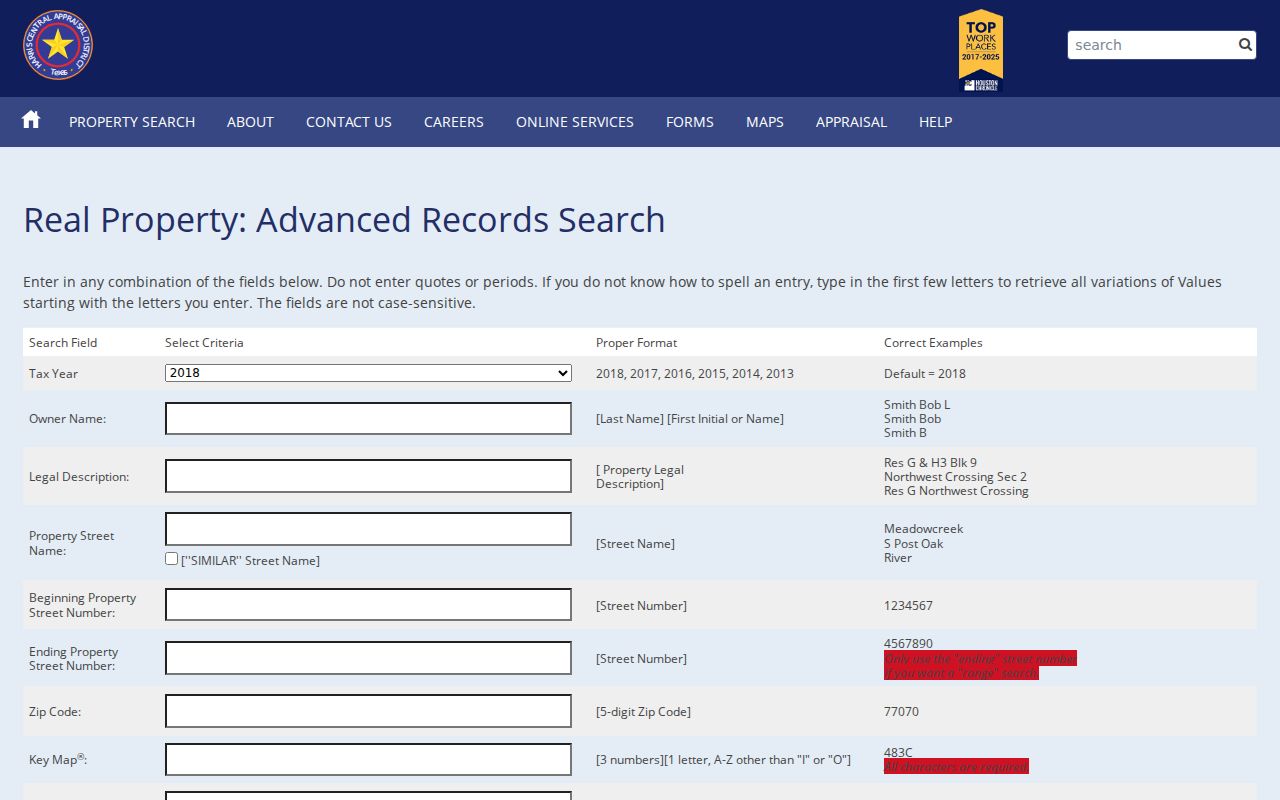
The form shows why a street, number range, and legal description often beat a broad name search.
Spring Deed Index Trail
The Harris County Clerk's real-property index turns a parcel clue into a recorded transaction trail. Search by grantor or grantee name, date range, subdivision, volume and page, or pieces like lot, block, unit, abstract, tract, and reserve. Enter names last name first with no punctuation. The index is free to search. It records the parties to an instrument, recording details, and legal-description clues. A grantor or grantee is not automatically a current resident. The portal publishes images from November 1, 1960 onward. Indexing can lag recording by one to two business days, and unwatermarked images or copies may require account or payment routes. Older deed books, direct and reverse indexes, office records, Texas State Library and Archives Commission microfilm, and Harris County Archives serve as documented fallbacks. The Clerk's pre-1961 indexing helps, but record the book, volume, film, and legal description anyway. Use the Clerk records search as a lead, then request a certified copy from the custodian when one is required.
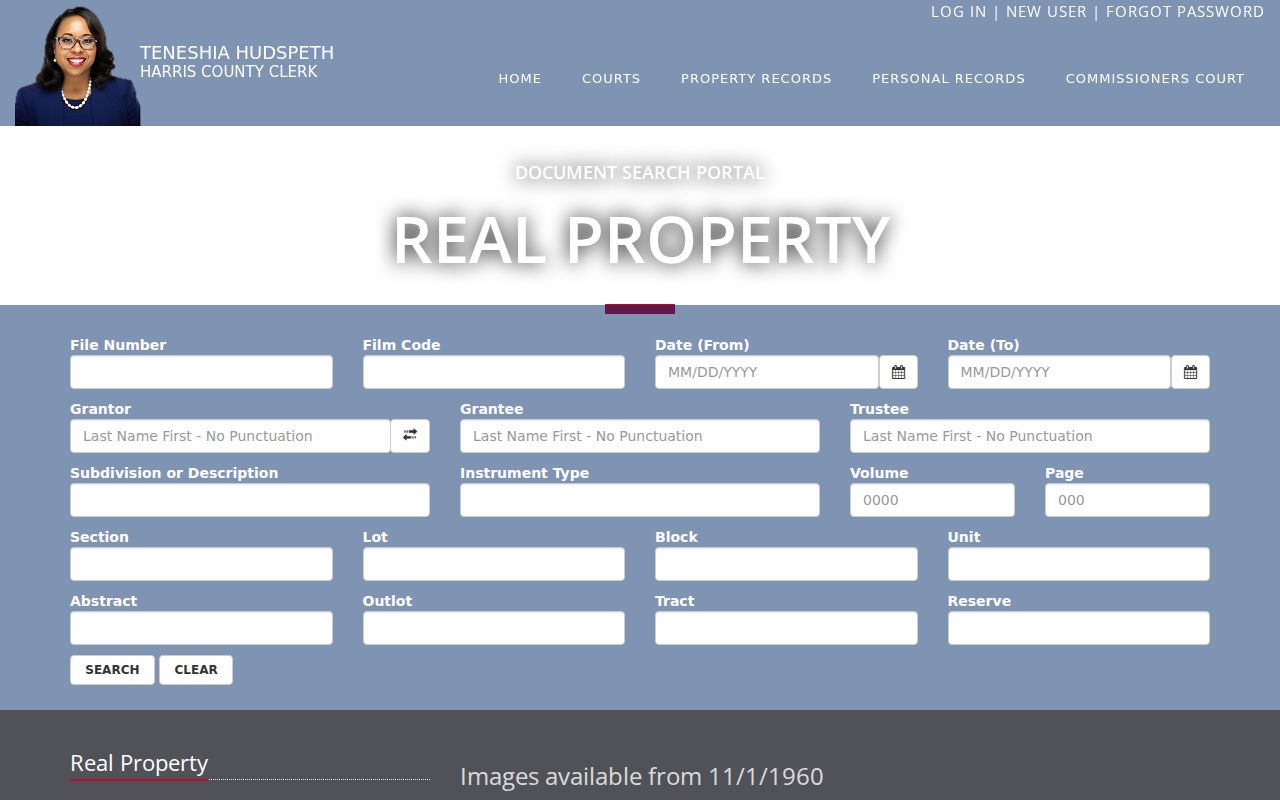
The Clerk's real-property search page displays the route used to document an instrument rather than infer an occupant.
Current Spring Residents Directories
Current records work best as a comparison set. The property roll names an appraisal owner and mailing information. A voter tool can confirm a current or pending registration. Suppression and status limits still apply. The deed index ties people to recorded instruments. Association databases reveal an association or its certificate filing, not its members. Date each source. Match it to the same address or name variant before combining them.
| Record layer | What it can show | Custodian | Access path |
|---|---|---|---|
| HCAD account | Owner, parcel, situs, mailing details | HCAD | Free web search and office |
| Voter registration | Current or pending registration result | Harris County | Web lookup or records request |
| Recorded instrument | Grantor, grantee, date, legal description | County Clerk | Index, copies, mail, counter |
| Association certificate | Association identity and filing clues | Texas management-certificate search | State search, not a member list |
Question: Does a voter result prove someone lives at the address right now? No. A Spring residents directory can be assembled from ownership, court, vital, and historical evidence. But each piece has limits. The Spring resident lookup route takes a name-first approach and sorts those record types apart. Registration can be pending, suspense, protected, or tied to a mailing address elsewhere. Treat a mismatched county or date as a lead to resolve. Never attach a record to a person on a guess.
Texas Voter Rules for Spring
Harris County gives Spring voters a straightforward voter search. Lookups run by name or by street address. Address searches need a directional form with no period. So type S Sam Houston rather than S. Sam Houston. Treat any result as a clue, not a block census. A neighbor may list a different mailing address. A neighbor may carry a protected address or sit in a ZIP you did not expect. The residents directory picture stays incomplete until you confirm details elsewhere in the county record.
What Texas does publish about a voter is limited but useful. Name, date of birth, a voter unique identifier, and participation history are public. How a person voted never is. Social Security numbers, driver-license data, phone numbers, and protected addresses stay restricted. Protected classes along with eligible survivors can join confidentiality programs that mask their details in the voter rolls. Some public displays show asterisks where an address would sit. Harris County also keeps a form that pulls personal information off its website while leaving the underlying record intact. That matters when you compare voter rolls against other Spring directory sources.
Formal voter-file requests follow a stricter path in Harris. Elections accepts written requests and allows in-person inspection for a documented file pull. The statewide Secretary of State form carries a notarized affidavit and a $75 deposit, with permitted reductions available and a 15-day furnishing rule on the books. It is a real records route, not a way around privacy protections.
Check the Harris lookup controls before choosing name or address as your angle.
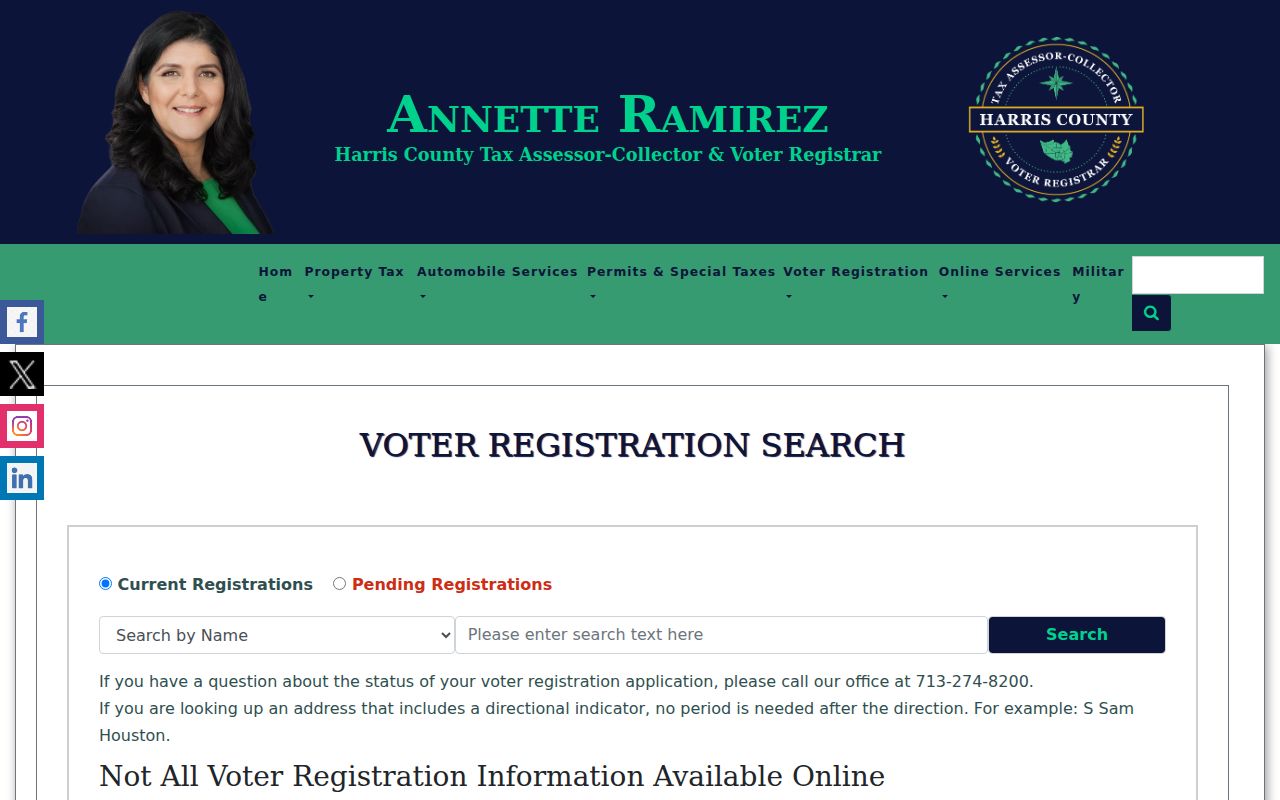
Current and pending registrations sit in separate buckets, so note the status any search returns.
Spring Court and Vital Checks
A name check sometimes leads through courts or vital records. Neither one works as a resident list, though. Harris County District Clerk eDocs splits into civil, family, criminal, and public-information areas. Modern case information there needs registration or login. Filters for party, role, filed date, status, court type, and case type help narrow things down. Older civil and criminal materials take an appointment-only document-room route. Texas State Library microfilm fills gaps in the historical record. Justice of the Peace cases, Houston Municipal Court records, and federal PACER cases all live under separate jurisdictions. Match the court to the record before you dig.
Vital records follow their own clock in Texas. Birth information opens to the public after 75 years. Death information opens after 25. Marriage and divorce verification indexes run from 1966 and 1968 at the state level. But the state will not hand you a certified marriage license or divorce decree. Those originals stay with Harris County or the proper issuing office. Restricted certificates demand a qualified applicant or direct tangible interest. For a smoother search, bring a date, a county, and an exact name rather than casting wide.
The Texas vital applications hub posts current forms. The named custodian for each certificate type is the right recorder to contact.
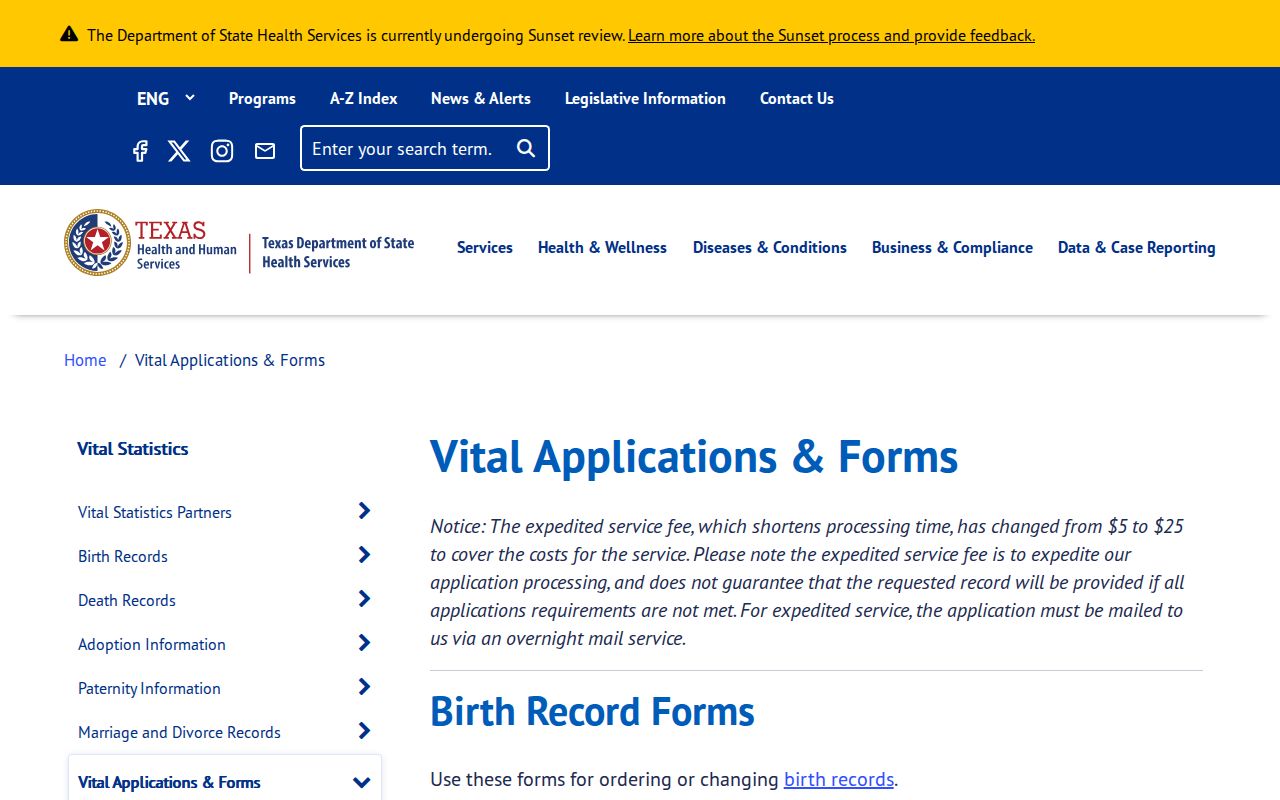
The state application hub splits vital records into separate paths. Birth, death, marriage, and divorce each get their own route, so one combined lookup file never happens at that portal.
Spring ZIP and County Boundaries
Spring carries more than one postal story. The Texas postal reference ties 77373, 77379, 77380, 77381, 77382, 77383, 77386, 77387, 77388, 77389, and 77391 to the Spring name. Those ZIPs do not draw the Census-designated place boundary. They do not draw the Harris County line either. A Spring 77386 address can point to Montgomery County records. A 77388 address hints at the Harris side but still needs parcel confirmation. USPS decides delivery addressing. It has no say over deeds, appraisal jurisdiction, school districts, MUDs, or courts.
HCAD's ZIP field can narrow a Harris County parcel search. It cannot prove that every result sits inside the Spring CDP. It also cannot prove that every person listed holds a Spring residence. Census TIGERweb and QuickFacts describe geography and population context, not household lists. The practical sequence runs USPS normalization first. Then comes a county parcel search, a legal-description check, and finally the appropriate county clerk.
For the full postal comparison, use the Spring ZIP code directory.
Historical Spring Directory Evidence
No continuous Spring-only city directory survives in the official collections. That gap matters. Spring began as a railroad village and postal place. It was never an incorporated city with a steady municipal directory of its own. Houston-area volumes, county material, newspapers, and archival collections still yield strong local clues. But a Houston directory entry should never become a Spring address without an independent check.
Houston Public Library posts free scans of its Houston city directories from 1866 through 1923. Later Houston runs sit in its physical holdings and at the Texas State Library. Criss-cross directories can reverse an address back to a household or phone listing. The Clayton Family History Research Center adds newspapers, funeral-home material, local-history collections, and staff research limits. Whenever you copy an entry, record the edition, page, section, spelling, and year. Then compare it against the 1950 Census, a deed, an obituary, or another archive source before you settle on a household conclusion.
Start with HPL's digitized city directories for the early open scans. The Harris County Clerk records search is the companion route. Use it when you need a parcel or instrument clue.

County records make a useful companion here. When a historical directory entry supplies a name but no dependable parcel match, the deed and recorder rolls can close that gap.
Spring Railroad-Era Record Gaps
Spring's records did not accumulate in a tidy line. Railroad history explains part of the uneven trail. The Houston and Great Northern Railroad reached the community in 1871, and the 1901 to 1903 connection turned it into a rail center. The roundhouse moved to Houston in 1923. Population shifted along with those changes. A thin early directory result can simply mean the town was a small railroad and postal community, served by a rural route, covered by a different publication scope, or skipped by a missing edition. It never proves a family was absent from Spring.
For the deeper trail, pair Texas State Historical Association context with Harris County deeds, probate, court, survey, newspaper, census, and archive collections. The Harris County Archives keeps permanent records from more than 70 county offices. Research visits run by appointment. TSLAC lists Harris deed and court microfilm, including older direct and reverse indexes. Write down the exact reel, volume, or book reference. That detail makes a later counter, library, or archive request far easier to fill.
Note: The District Clerk and TSLAC flag missing historical criminal-minute volumes, so a volume gap is a custody fact rather than evidence about any individual.
Spring Public Records Request Route
Some useful indexes never reach the internet. Then go to the office holding the original. The Texas Public Information Act, Government Code chapter 552, backs a written request for existing public records. Name the custodian. Describe a narrow record set. Add the relevant address, legal description, file number, person name, or date range, and state whether inspection or copies are preferred. The Attorney General says no reason is needed. A request still cannot ask an office to create a new report or run a broad investigation.
The agency should provide records promptly. If ten business days pass, it should say when the records will be available or explain the delay. Costs may need an itemized estimate, and larger requests can require a deposit. The Clerk, Elections, District Clerk, archives, HPL, TSLAC, and the right city office all offer fallback paths. A Houston municipal request fits only when jurisdiction truly points to Houston. Review the Texas Public Information Act overview before submitting.

Once the right custodian is clear, the Attorney General's overview is the place to shape a scoped request. Keep it narrow and written.
Spring Elections Request Access
Harris Elections offers more than a web lookup. Written public-information requests can go to the Harris County Clerk Elections Department, which also runs an in-person inspection route. Its guidance asks requesters to describe the record. Inspection is free. Estimates can apply above $40, and deposits above $100. That route reaches only existing, releasable records. It cannot defeat address confidentiality or turn a registration file into proof of residence.
Keep each request narrow. An address, status, election date, or named file field helps the office route it quickly. For statewide data, use the Texas Secretary of State's prescribed request and affidavit rather than assuming the county website holds the master file. Public data carries practical and legal limits, especially around protected address information. Harris Elections explains its formal request route at the source below.
The guidance separates formal requests from simple lookups.
Spring Residents Directory History
Every historical source keeps its own meaning. A city directory is a published snapshot, while a deed records a property transaction. A census captures a household in one moment. An obituary reports an event. HCAD is an appraisal account. Matching dates let the records reinforce each other. When they conflict, keep the conflict intact and return to the original edition, instrument, or index instead of forcing a match.
HPL's address-search service has firm limits. By email it covers roughly one address across five chosen years, or two addresses across two or three years, under a monthly request cap. That measured service works well when a volume is not digitized. Older Harris deed books, TSLAC microfilm, and Archives title materials can bridge an address change. The Spring directory book page details the collection years, reading method, and access limits.